Saturday, December 8, 2018

Petrichor: First Thoughts (Part Two)

A Lesson in Thinking Ahead

My last post was very much a "straight from my head to my keyboard" sort of post. It was a good brainstorm, but I think tonally speaking it is a little off from what I was looking for. I'm still excited by my cycle, but I think it needs a little tweaking. Let's try:

Age of Grey => Age of Storms => Age of Steam

Part of my aversion to the way I'd sequenced my cycle before is that all signs pointed to the big thing that I'd build lore around was going to be a torrential downpour leading to a flood. That's not bad, but I feel as far as calamities go, great floods are adequately represented in media and mythologies. 

Age of Grey - The world is desolate (again). Sunlight is obscured by the thick layer of clouds that prevent anything other than fungus and pallid creatures from living on the surface. Humanity begins to emerge from their caves like tar bubbling up from a primordial pit.

Age of Storms - The rains begin and start to thin the clouds. At times, enough sun shines through to support sustainable farming and the development of civilization. With civilization comes plenty, and with plenty comes wanting. The world is wild and empires rise and fall below the storming skies.

Age of Steam - The sun breaks through. The seas boil up and the air is filled with scalding steam and hot water geysers. Humanity has retreated to below the surface and power is seized by those who have the knowledge to harness the immense power of the now-unleashed sun.

I think this fixes my issues with my Water Cycle 1.0 -- instead of a great flood, the natural calamity is the emergence of the sun and the boiling of the oceans, which leads us to our scheduled topic.

Worldbuilding based on Problem-Solving

Problem Statement- The clouds are thinning, and the Age of Storms is due to end. The unveiling of the Sun will herald in the new Age of Steam.
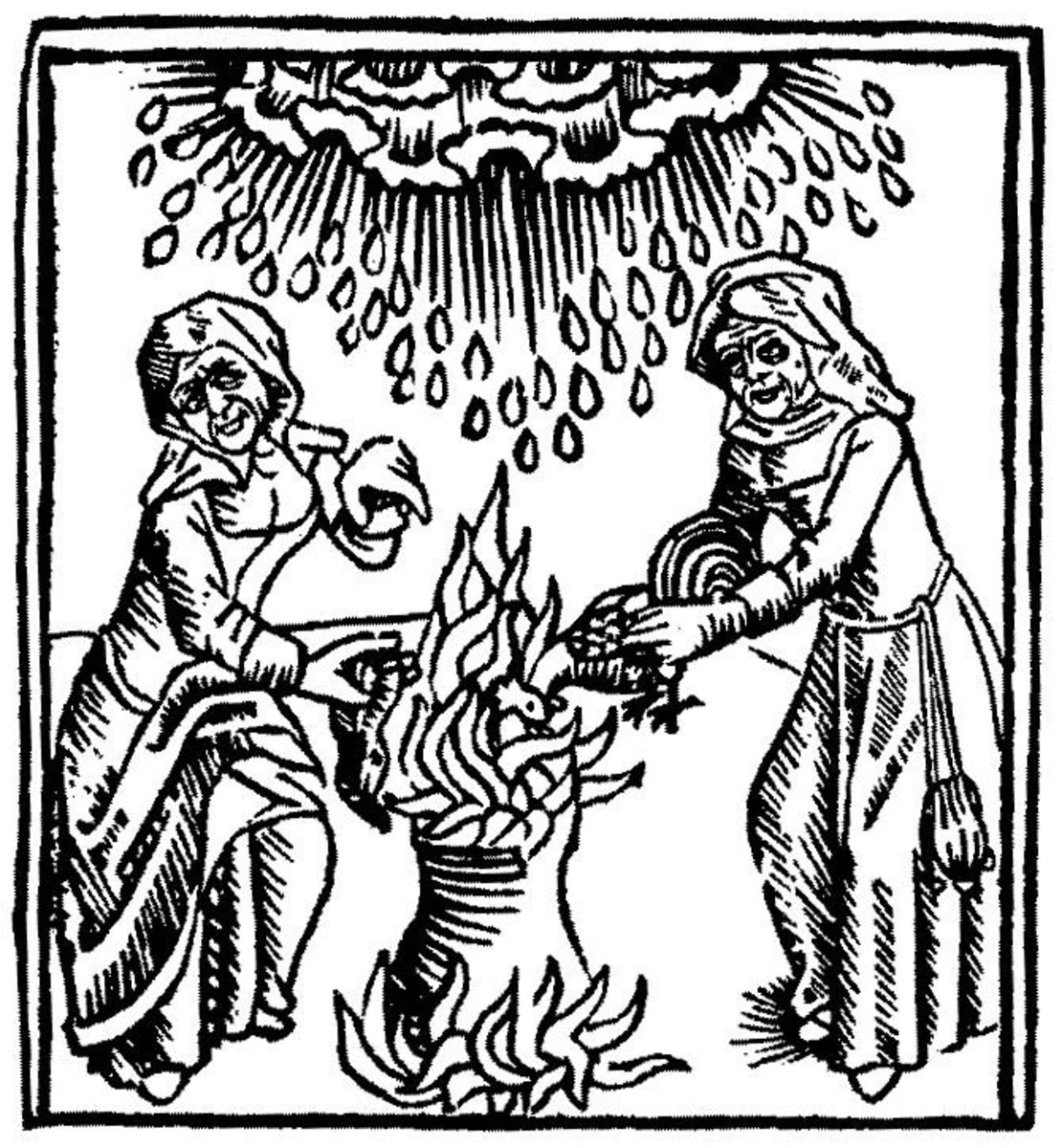
Image result for witches raising a storm

Solutions (and their Evidences)-
  • The Witchmother Ruth attempts to summon more clouds from the Netherworld after her children are incinerated by a Sunspot. She tore a rift and let through much more than just clouds.
    • A cabal of stormcaller witches with a tradition of sacrificing children
    • Runic circles for summoning clouds
    • Aberrations and demons from the Netherworld who have made it through
    • Sunspots, the occasional breaks in cloud coverage that allow the unfettered destructive power of the sun to shine through
    • Arcane barometers used to determine if demons are near
    • Ruth's Cloud-cloak
    • "The Strongest Storms Arise from Below"
fantasy-art-engine:  Ancient Shrine by Marco Gorlei


  • The Druid-Prince Ezekiel attempts to siphon power from the Sun when his father the Druid-King begins to go mad upon contemplating the inevitable incineration of his kingdom. He siphoned far too much.
    • The Sunlight Court, a place of light and fire
    • Shapeshifters leak sunlight from their eyes
    • Sunpools, places of highly concentrated sun-power that can be drawn upon as places of power
    • Pre-fabricated wands that harvest solar power to cast a limited number of spells
    • "Sunlight Powers our Ambitions"
  • High Arthropod Ezra fashions great clouds of platinum metal locusts when he discovers evidences of a past Age of Steam. He lost control of his swarms and himself.
    • Roving packs of platinum locusts that have seized control themselves
    • Miles upon miles of shredded farmland
    • Dead platinum locusts, looted as ornamentation
    • Steel-mesh bug screens
    • Ezra's tools, used to bring a new race of insect into the world
    • "From Hammers Arises a Swarm"
Desert locust swarm approaching Nouakchott (Mautania 1993). BUT.... in Kenya in 1954, 77 square miles  were ravaged when 1 huge swarm of locusts, numbering 10 BILLION descended on the land.


  • Citizen Jeramiah "The Governor" leads his people to embrace the emergence of the sun when his climatologists warn of the impending immolation. He started far too early.
    • An egalitarian city celebrating the potential apocalypse while acknowledging the many that will die
    • Steam-powered devices and machinery
    • Suits of power-armor that could be used to withstand the sun
    • Well-stocked vaults to hold his people

Friday, December 7, 2018

Petrichor: First Thoughts

The Pitch

Like many referees before me, I am absolutely captivated by the world-building exemplified in the Dark Souls series of games. The lore is a convoluted, grim affair of names and figures and factions circling around a highly abstract, highly poetic concept: the death of the Age of Fire. Whatever that means.

I have seen this style of lore-delivery and world-building -- or at least how it can relate to role playing games -- framed in two ways by Skerples at Coins and Scrolls, and Daniel Davis of gg no re:  

1. Cycles. Something big, ostensibly beyond the control of the PCs or any NPCs in the world, is about to change. Something world-shaking, something that was foreseen. Investigation into the world and its ruins will reveal that this is something that has happened before. A focus on the cycle adds a certain timelessness to the game. (The flow of time is convoluted in Lordran...) Although the players as always have the ability to completely ignore the big thing, there is never any doubt that it is central to the world and runs through items, magic, and history.


2. Conflicts. As with cycle-centric worldbuilding, everything is defined by the big thing. However, this time lore is built by examining the different ways that people have tried to fix it. Great powers take action by creating artificial versions of the thing, attempting to extend the life of the thing, attempting to make people who don't need the thing--- whatever. In the process, they create factions, locations, and items that can be drawn upon by an enterprising referee designing adventures and attempting to engage players.

I like both of these. I think both of them are valuable. So for my next campaign, I am going to try to create a setting that is thoroughly interwoven with a central cycle and a history of conflicts.

Dark Souls did fire. What about water?

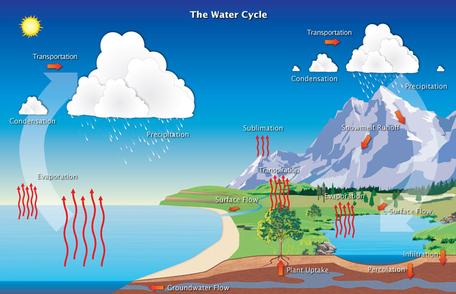
Image result for water cycle picture
I think it's safe to say we need to cut down on the detail here. My players would acknowledge that I am prone to falling in love with complicated details and worlds, and many times my ideas are too complex for me to improvise the delivery. To me, the main engaging details here are: clouds, rivers (surface flow), rain, and the sun (evaporation). There might be something in percolation and infiltration-- after all, subterranean delves are eminently gameable, but they're not striking me at the moment, so I'll leave them for now.

Image result for boiling oceans art
Vladimir Mesheryakov
The Age of Sun

A time of desolation. The oceans are boiling, and the air is filled with blinding sunlight and thick steam as it rises into the heavens. Life is scattered sparingly throughout the world-- there are thick-shelled beasts living deep within the scalding oceans who can withstand it's heat, and fluttering flighty creatures who flit about among the geysers and gushing vapors. 


Humanity is almost certainly limited to isolated pockets of civilization living in caves or sheltering within those ruins that were not destroyed by the storms that preceded them. They are torn apart by scarcity, but have adapted somewhat to living within their chthonic environments. In any age, certainly, there are those who benefit. Rare mages and rarer engineers are able to harness the power of the steam to power great machines that support these few communities at the cost of worship and adulation.

File:John Constable - Flatford Lock - Google Art Project.jpg
John Constable - Flatford Lock

The Age of Clouds

A time of peace and plenty. The super-critical seas have boiled off enough to obscure the harsh light of the sun, tempering the heat and uncovering fertile grounds. The monsters that were developed enough to survive the conditions during the Age of Sun find themselves tougher and stronger than their emerging competing species, but unable to sustain their great forms without the constant influx of energy from the steam and the sun. The oceans and land teem with life aplenty, and humanity emerges from their caves to construct great cities and empires. 

Trade flourishes between competing city-states as caravans of trade goods pass back and forth. Luxury begets coveting, and coveting begets war as leaders convince their followers to seize what they believe they rightfully deserve.

File:Petrus van der Velden - Storm at Wellington Heads - Google Art Project.jpg

Petrus van der Velden - Storm at Wellington Heads


The Age of Storms

A time of punishment. The clouds have thickened enough that the world is cool and wet. One day the rain starts and does not stop. Farmers and traders find it more and more difficult to do their work, until waterlogged fields and mud-slicked wagons are left for useless. Great lightning strikes and war-drum thunder echoes throughout the world, blasting the domes and towers of humanity into stony ruins. The coastline has receded greatly and forced people into tighter and tighter spaces, exacerbating existing conflicts and destroying resources that are needed to survive.

Piracy and opportunistic profiteering is rampant in the apocalypse. Civilization has been reduced to a fraction of its former self, and the distant descendants of those who manage to eke out a living form the seeds of the scattered tribes that will retreat deep beneath the earth when the power of the sun is no longer held back by rain-depleted clouds.

Elegy to the First Son

Slowing, falling, ever-calling, crashing under eldritch crushing, whisp'ring, seeping, ever-weeping, tearful broken first-born son. ...